Neuroevolution and Direct Policy Search
Continuous State, Continuous Action
- Approximating \(Q(s, a)\) does not help, we cannot (simply) determine \(\arg\max_a Q(s, a)\) to infer a policy.
- We can discretize \(A\).
- Instead, we can approximate \(\pi_{\boldsymbol{w}}(s) = a\) directly (direct policy search).
Parametrizable Policy
- Neuroevolution: Artificial neural network (ANN) which maps states to actions
- Weight vector \(\boldsymbol{w}\) can be modified
Optimizer
- Gradient-free optimizer (because we cannot determine the correct action)
- Usually either
- evolutionary algorithms (e.g. CMA-ES, CoSyNE, ...) or
- RL algorithms (e.g. RWR, PoWER, \(PI^2\), REPS, ...)
- Adjusts \(\boldsymbol{w}\) to maximize the return (sum of rewards)
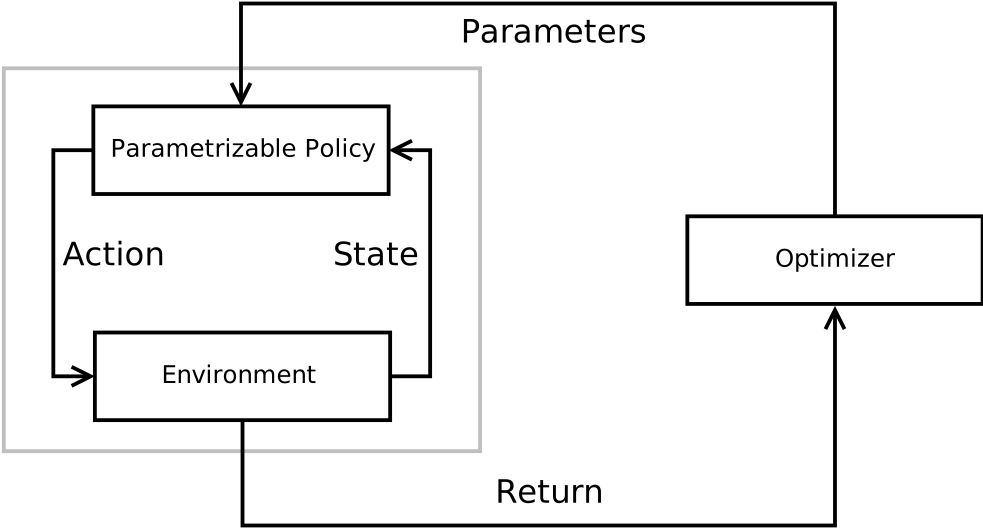
Neuroevolution
CMA-ES
- Covariance Matrix Adaptation Evolution Strategy
- Derivative-free optimization algorithm, mimimizes fitness functions that are
- non-linear
- non-separable
- noisy
- ill-conditioned
- Should not be used
- for a very small number of parameters
- for a very large number of parameters (requires inversion of a covariance matrix)
- if exact derivatives are available
- See Nikolaus Hansens's webpage or Wikipedia for more details.
In [1]:
%pylab inline
In [2]:
def objective(x):
    return sqrt(x[0]**2+x[1]**2)
In [3]:
def plot_objective():
    x, y = meshgrid(arange(-1.6, 1.6, 0.1), arange(-1.6, 1.6, 0.1))
    z = [[objective([x[i,j], y[i,j]]) for i in range(x.shape[0])] for j in range(x.shape[1])]
    contourf(x, y, z, cmap=cm.Blues)
    setp(gca(), xticks=(), yticks=(), xlim=(-1.5, 1.5), ylim=(-1.5, 1.5))

figure(figsize=(5, 5))
plot_objective()

In [4]:
def equiprobable_ellipse(C, factor=1.0):
    """Source: http://stackoverflow.com/questions/12301071/multidimensional-confidence-intervals"""
    def eigsorted(C):
        vals, vecs = linalg.eigh(C)
        order = vals.argsort()[::-1]
        return vals[order], vecs[:,order]
    vals, vecs = eigsorted(C)
    angle = arctan2(*vecs[:,0][::-1])
    width, height = 2 * factor * np.sqrt(vals)
    return angle, width, height

def plot_ellipse(C, mean=zeros(2)):
    from matplotlib.patches import Ellipse
    angle, width, height = equiprobable_ellipse(C)
    e = Ellipse(xy=mean, width=width, height=height,
                angle=degrees(angle), ec="orange",
                fc="none", lw=3, ls="dashed")
    gca().add_artist(e)
In [5]:
__import__("sys").path.append("05_neuroevolution")
from barecmaes2 import Cmaes
opt = Cmaes(xstart=[1.0, 1.0], sigma=0.1, ftarget=1e-10, popsize=50)
In [6]:
def plot_generations(n_generations):
    figure(figsize=(n_generations*4, 4))
    for it in range(n_generations):
        X = asarray(opt.ask())
        F = [objective(x) for x in X]
        subplot(1, n_generations, it+1)
        plot_objective()
        plot_ellipse(C=opt.sigma*asarray(opt.C), mean=opt.xmean)
        weights = zeros_like(F)
        weights[argsort(F)[:len(opt.weights)]] = opt.weights
        scatter(X[:, 0], X[:, 1], c=weights, cmap=cm.gray)
        opt.tell(X, F)
In [7]:
plot_generations(n_generations=3)

In [8]:
plot_generations(n_generations=3)

In [9]:
plot_generations(n_generations=3)

Double Pole Balancing
In [10]:
from IPython.display import YouTubeVideo
YouTubeVideo("5y3UTEgFH2Q")
Out[10]:
Octopus Arm
In [12]:
YouTubeVideo("AxeeHif0euY")
Out[12]:
TORCS
In [14]:
YouTubeVideo("3JiNC6vw8zE")
Out[14]:
This problem also has been solved with visual input.
Partially Observable Markov Decision Processes (POMDP)
Markov property:
\[P(s_{t+1}|a_t,s_t,\ldots,a_0,s_0) = P(s_{t+1}|a_t,s_t)\]
But we cannot observe \(s_t\) completely!
Question 1
Can you give examples for partially observable Markov decision processes?
Question 2
How can we deal with partial observability?
Answer 2
- State estimation
- Bayes filters (e.g. particle filter, Kalman filter)
- Exponential smoothing
- \(\boldsymbol{\alpha}\)-\(\boldsymbol{\beta}\) filter
- ...
- Use recurrent connections
- We need some kind of memory
Smoothing Noisy Observations with \(\alpha\)-\(\beta\) Filters
In [16]:
class ABF(object):
    """Alpha-beta filter."""
    def __init__(self, g, delta):
        r = (4+g-sqrt(8*g+g**2))/4
        self.a, self.b = 1-r**2, 2*(1-r)**2
        self.delta = delta
        self.s, self.sd = None, None
    def step(self, s):
        if self.s == None: self.s, self.sd = s, zeros_like(s)
        se = self.s + self.delta * self.sd
        sde = self.sd
        r = s - se
        self.s = se + self.a * r
        self.sd = sde + self.b/self.delta * r
        return self.s, self.sd
In [17]:
random.seed(0)

steps = 100
X = linspace(0, numpy.pi*4, steps)
S = sin(X)
Sn = S + random.randn(*S.shape)*0.2

figure(figsize=(12, 5))
plot(Sn, label="Observation")
plot(S, label="Signal")
r = legend()

In [18]:
abf = ABF(g=0.05, delta=1.0)

SE = []
SDE = []
for s in range(steps):
    se, sd = abf.step(Sn[s])
    SE.append(se)
    SDE.append(sd)

figure(figsize=(12, 5))
plot(Sn, label="Observation")
plot(S, label="Signal")
plot(SE, label="Estimation")
r = legend()

Policy Search in Robotics
- Often we use a policy of the form \(\pi(s_t) = s_{t+1}\), that maps from a state to its successor.
- \(\pi\) generates a trajectory.
- We can use low-level controllers to generate an action that transfers from \(s_t\) to \(s_{t+1}\).
- We can even work in task space (e.g. Cartesian end-effector coordinates):
- We need inverse kinematics (IK) to determine joint angles
- We could use inverse dynamics to determine torques
Policy Representations in Robotics
General function approximators
- Gaussian mixture models
- Gaussian process regression
- Radial basis functions
- Neural networks
Nonlinear dynamical systems
- Stable estimators of dynamical systems (SEDS)
- Dynamical movement primitives (DMP)
- Parametric dynamical movement primitives (PDMP)
Via points and splines
- Probabilistic movement primitives (ProMP)
- Bézier splines (B-splines)
- ...
Applications in Robotics
- Ball throwing
- Darts